Emotional Intelligence for New Managers: The First 90 Days
- new-manager
- emotional-intelligence
- leadership
- first-time-manager
The first management role is the hardest job transition in most careers.
Not because management is harder than individual contribution — it’s a different kind of hard. The skills that got you promoted (technical depth, individual output, reliability under pressure) are not the skills the new role demands. The skills the new role demands (giving feedback, navigating ambiguity, reading the room, holding space for other people’s anxieties) are mostly emotional intelligence skills, and very few first-time managers have been trained in them.
The result is a recognizable pattern. The new manager works harder than ever, the team underperforms anyway, and within six months either the manager burns out or the best person on the team quits. A surprising number of “bad managers” are first-time managers who never got the right scaffolding.
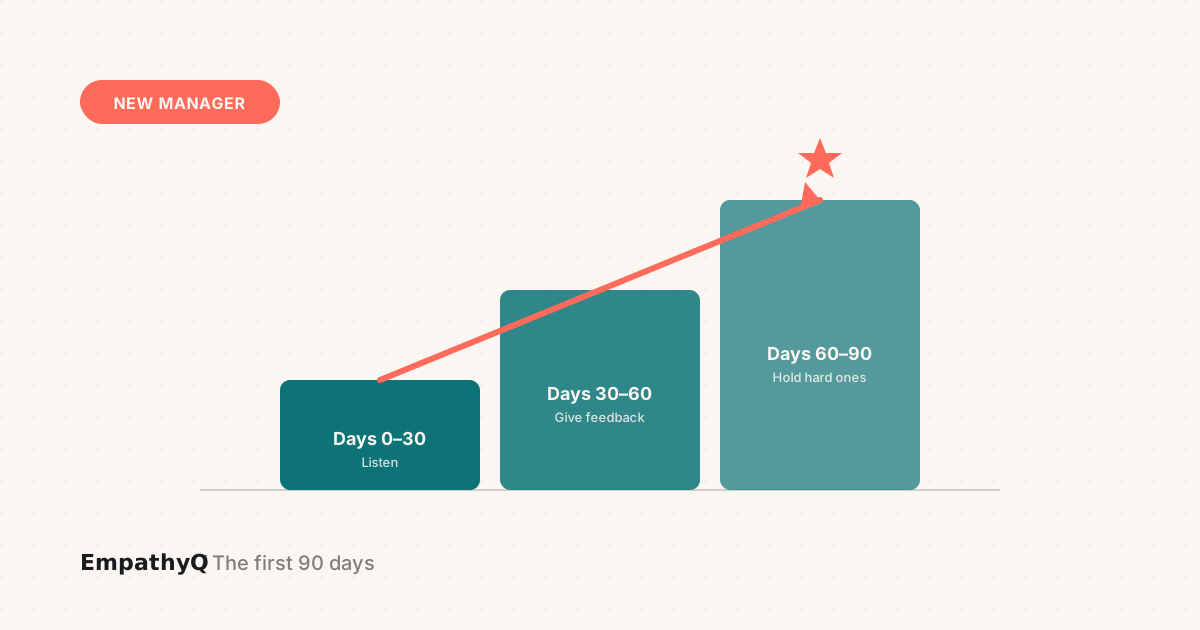
Here’s what to actually focus on in the first 90 days, organized around the EQ skills that matter most.
Days 0–30: Listen more than you think you should
The single biggest mistake new managers make is acting too fast. You’ve been promoted; you want to demonstrate value; you have ideas about how things should change. So you change them.
Don’t.
The first 30 days are for calibration, not action. You’re trying to understand:
- What does each person on the team actually do, day-to-day?
- What are they worried about that they haven’t said out loud?
- What does “good” look like to them, and how does that compare to what your boss thinks “good” looks like?
- Where are the trust gaps? With you, with each other, with the org?
You cannot answer these by reading docs or studying the org chart. You answer them by talking to people, asking specific questions, and shutting up long enough to actually hear the answers.
The EQ skill on the line here is empathy — but the operational version, not the abstract one. You’re not trying to feel what they feel. You’re trying to register, accurately, what they’re carrying so you can manage them well.
One concrete habit for days 0–30: End every 1:1 by asking “what’s one thing you want me to know that I don’t know yet?” Then, importantly, write the answers down. Patterns will emerge by week three.
Days 0–30: Notice your own reactions
The other half of the first month is interior. You are about to be triggered in ways you haven’t been triggered before, by situations you didn’t know existed.
- A direct report disagrees with you in front of the team. You feel something — maybe anger, maybe a flash of “they don’t respect me.”
- You give a piece of feedback and it doesn’t land. You feel something — maybe embarrassment, maybe a small panic.
- Your boss asks why a project is behind. You feel something — maybe a defensive urge to blame the team.
Each of these is a chance to build self-awareness. The task is not to suppress the reaction. It’s to notice it, name it, and not act on it immediately.
The simplest version of this habit: when you notice a strong emotional reaction, write down (1) what triggered it, (2) what the feeling was, and (3) what you almost did. Five minutes a day, for thirty days. By the end of the month you’ll have a much clearer map of your own reactivity than you started with — and the map alone slows the reactions down.
Days 30–60: Start having the conversations
By day 30 you have data. By day 60, you’ve spent that capital — for better or worse — on actual decisions.
The single most important capability for this phase is giving direct, useful feedback. Almost every new manager underestimates this. They wait until performance review season. They drop hints. They hope the person will figure it out. They give feedback that is so softened the recipient leaves convinced everything is fine.
Don’t.
Use a structure. SBI-I — Situation, Behavior, Impact, Inquiry — is the version we teach inside EmpathyQ. Anchor to a specific moment. Describe behavior, not personality. Name the impact. End with a real question. (We’ve written a longer guide on constructive feedback if you want the full version.)
Two things matter in this phase:
-
The first feedback conversation sets the tone for everything after it. If you bury the message, your team learns that your feedback is filtered. They will stop trusting it. From that point, every kind word is suspect and every criticism feels like the surface of something worse.
-
You will get it wrong. Especially the first few times. That’s fine. The skill is built through reps, not by getting it right on the first try.
Concrete habit for days 30–60: Give one piece of specific, behavioral feedback per week. Half of it should be positive. Both halves should be specific. “Good job on the launch” doesn’t count. “The way you ran the launch retro — pulling out the three concrete fixes and assigning owners by name — was exactly the kind of thing I want more of” does.
Days 60–90: Hold the hard conversations
By day 60, you’ll have spotted the harder issues. Maybe someone on the team isn’t pulling their weight. Maybe two of your reports are in a slow-burn conflict. Maybe a senior person is checked out and quietly looking elsewhere.
The pattern that produces the most damage in this phase is avoidance. The new manager sees the issue, knows it’s an issue, and finds reasons not to address it: I’m new, I should observe more, it might resolve on its own, the timing is bad.
It does not resolve on its own. The team is watching whether you handle the obvious thing. If you don’t, two things happen: the obvious thing gets worse, and the team learns that you don’t handle obvious things, which means everything else gets worse too.
The relevant EQ skill here is self-regulation — the capacity to feel the discomfort of a hard conversation and have it anyway, in a way that’s calm and clear instead of reactive and escalatory.
This is the phase where preparation matters most. Before any hard conversation, do the 15-minute prep:
- Goal in one sentence
- Specific examples (situation, behavior, impact)
- Most charitable interpretation of their behavior
- One question to surface their view
- Concrete next step
If you can’t fill these in, postpone — but only by 24 hours, not by 24 weeks.
Concrete habit for days 60–90: Identify the conversation you’re most avoiding. Have it within two weeks.
What changes at day 90
The first 90 days are not about getting it right. They’re about establishing the operating model: how you listen, how you give feedback, how you handle hard things. Once that operating model is set, the team adjusts to it, and the second 90 days get easier.
The managers who struggle in year two are almost always the ones who used the first 90 days to avoid setting an operating model — they kept things friendly, didn’t deliver hard messages, and quietly let the team form a model that the manager isn’t going to do anything difficult. That model is hard to undo.
The skill underneath all of it
Every habit in this article is, underneath, a flavor of one capability: the ability to feel your own discomfort and act well anyway. That’s the core EQ skill of management. Self-awareness lets you notice the discomfort. Self-regulation lets you not react to it. Empathy lets you stay tuned to the other person while you’re managing your own state. Social skills are how it shows up in the conversation.
You can read about all of these. You build them through reps.
This is what EmpathyQ is for. You can practice the hard 1:1, the feedback conversation, the conflict de-escalation, before you have to do it for real — and get specific feedback on whether you held substance, where you flinched, and what landed differently than you intended. The first 90 days are a steep learning curve. The reps make it less steep.
If you take only one thing from this: the work is in the conversations, and the conversations don’t get easier by avoiding them. They get easier by having more of them, with structure, with practice, and with honest feedback.