How to Handle a Defensive Employee in 1:1s and Performance Reviews
- difficult-conversations
- feedback
- management
- performance-reviews
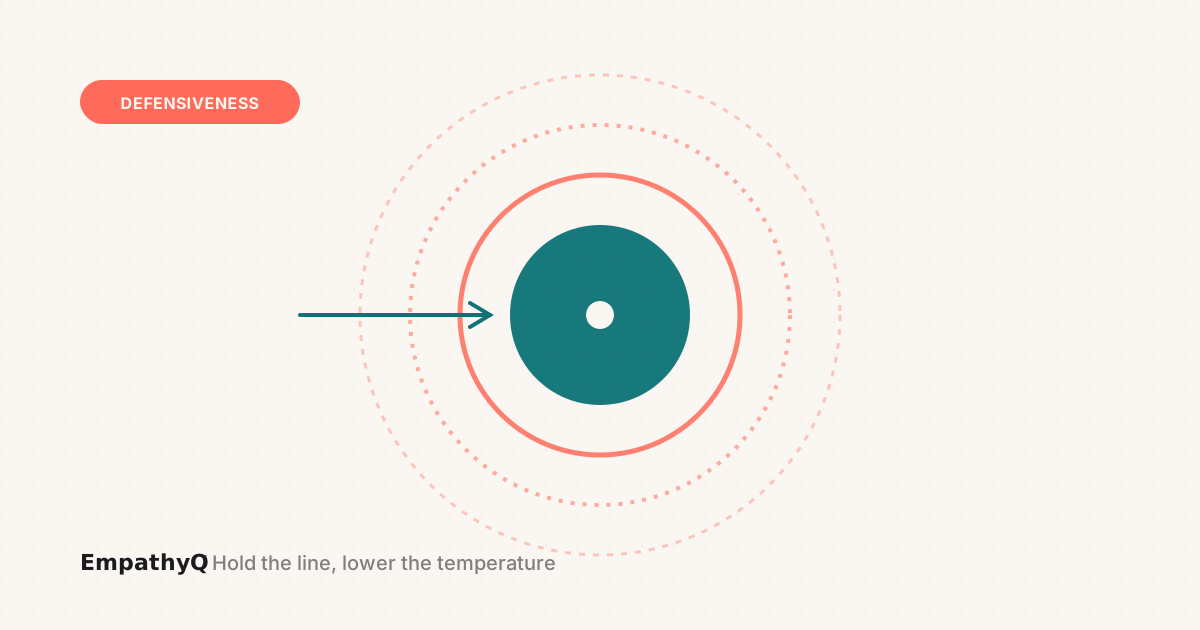
You’ve prepared the feedback carefully. You’ve used SBI. You’ve been specific, behavioral, and kind. You deliver it.
And then they get defensive.
They interrupt. They counter every example. They explain why each situation was different. They flip it — “actually, the real issue is…” — and now somehow you’re the one being critiqued. You leave the meeting with a knot in your stomach, the substance unaddressed, and a quiet conviction that you should have just let it go.
This is one of the most common failure modes in management. The good news: the defensive reaction is usually predictable, and there’s a small set of moves that work. Here’s how to handle a defensive employee without softening the message or escalating the conflict.
What defensiveness actually is
Defensiveness is not a personality trait. It’s a threat response. The brain perceives the feedback as an attack on identity (“I’m a good engineer / good team player / good person”), and the body responds as it would to any threat: heart rate up, blood to the muscles, attention narrows.
In that state, people genuinely cannot process feedback. The information goes in but bounces. This is why “just listen to what I’m saying” doesn’t work — they can’t, until the threat response calms down.
So the first job is not to deliver more feedback. It’s to lower the temperature enough that they can actually hear you.
Move 1: Name what’s happening — gently
Most managers either ignore the defensiveness (and keep escalating their case, which makes it worse) or call it out aggressively (“you’re getting defensive”). Both fail.
A better move: acknowledge the reaction without making it a fight.
“I can see this is landing hard. That’s fair — I knew it would. I want to slow down.”
You’ve named the emotional reality of the room without accusing them of anything. You’ve also signaled that the conversation isn’t going to be a barrage. That alone often takes the temperature down two notches.
What you have not done: retract the feedback. The substance is still on the table.
Move 2: Get curious about the resistance
Defensive people are usually defending something specific. Find out what.
- “Help me understand what’s not landing.”
- “What part of this feels off?”
- “Is there context I’m missing?”
These are real questions. If you ask them with genuine curiosity, you’ll often learn something useful — maybe they had told you about the blocker and you missed it, maybe they read your email as accusatory when you didn’t intend it that way, maybe there’s a peer dynamic you didn’t know about.
If you ask them rhetorically, as a setup for your next attack, they will smell it and dig in further.
The job here is to separate two things you’ve been bundling: the content of the feedback (which you may still believe is correct) and the context around it (which you may not fully understand).
Move 3: Hold the substance, soften the delivery
Here is the key move, and the one most managers get wrong.
When someone gets defensive, the instinct is to either push harder (“no, it really is a problem, and here’s another example”) or retreat (“you know what, let’s talk about this another time”). Both are mistakes.
Push harder and you confirm their threat response. Retreat and you teach them that defensiveness ends the conversation.
The right move is to hold the substance while explicitly softening the delivery:
“I’m not trying to argue who’s right. I want to share what I’m seeing, hear your version, and figure out together if there’s something to change. The thing I’m seeing is —” (repeat the original feedback, calmer, more specific)
You said the same thing. You said it with less heat. You named your intent. The substance has not moved.
This is the move that takes practice, because in the moment it feels like you’re being too soft. You’re not. You’re keeping the message clear and the room safe enough for it to be heard.
Move 4: Don’t argue the past — orient to the future
Defensive conversations almost always get stuck in litigation: “I did do that.” “No you didn’t.” “I have an email.” “But the email said —”
You will never win this. Even if you do, you’ve spent your political capital winning a debate instead of changing behavior.
When you feel the conversation pulling toward “who is right about what happened,” redirect:
“I think we may remember it differently, and I’m not sure we’ll resolve that today. What I care about is the next two weeks. Here’s what I’d want to see going forward —”
This move costs you nothing. Conceding the past is cheap. Getting alignment on the future is the whole point.
Move 5: End with a clear ask, not a conclusion
A defensive 1:1 will often end with the employee saying something like “okay, I hear you, I’ll think about it.” Do not accept this as a resolution. It almost never is.
Instead, get to a specific thing:
- “Can we agree that for the next two sprints, you’ll Slack me by Wednesday if anything’s at risk for the Friday deadline?”
- “Would you be open to me jumping into your next 1:1 with Priya, just to listen?”
- “Let’s revisit this in three weeks. I’ll send a calendar hold.”
The conversation can end without agreement on the past. It cannot end without alignment on the next concrete step. Otherwise nothing changes, and the next time you raise it the defensiveness will be worse.
What if they cry, shut down, or get angry?
These are emotional escalations, not different categories. The same rules apply: name what’s happening gently, slow down, hold the substance, redirect to the future.
If someone is genuinely too activated to continue, end the meeting. Not as retreat — as recovery.
“I want to give this the time it deserves. Let’s pause and pick this up Thursday. I’ll send a hold. Same agenda.”
You’re modeling that hard conversations don’t have to be one-shot. You’re also signaling that the conversation will happen — just not while either of you is too dysregulated to use it.
The honest part
Some employees are chronically defensive in a way that no amount of skill on your part will fix. Holding feedback firmly with someone who refuses to hear it, week after week, eventually becomes a performance issue — and at that point, the conversation shifts from coaching to documentation.
But that’s the minority. Most “defensive” employees are competent people whose threat response is firing in conversations they don’t have a good model for. The fix is rarely “you need a different employee.” It’s usually “this conversation needs better technique.”
Practice the move that’s hardest for you
If you read this and one move felt easy and another felt impossible, that’s the one to rehearse. For most people it’s Move 3 — holding the substance while softening the delivery. The mouth wants to either push or retreat, and the third option only becomes available with practice.
That’s the gap EmpathyQ is built to close. You can role-play a defensive employee with an AI that pushes back the way real people do, and get specific coaching on whether you held the substance, where you flinched, and what landed differently than you intended. Five minutes of that the night before a hard 1:1 changes how the conversation goes.
Defensiveness is not the end of the conversation. It’s the start of the real one.